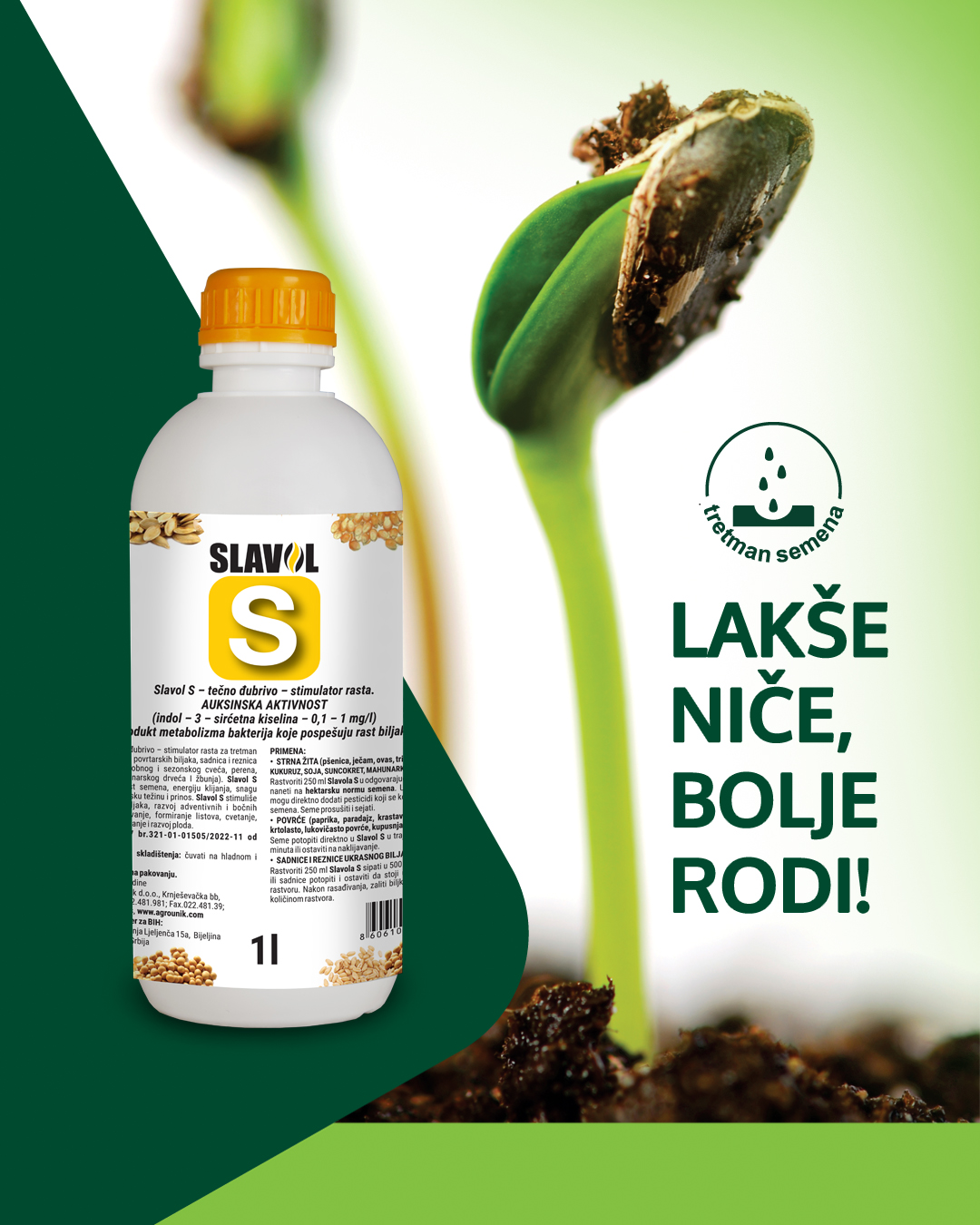
Slavol S is a certified liquid fertilizer that stimulates and improves plant growth, both in conventional agricultural production and in demanding organic production systems. It is intended primarily for the treatment of seeds of arable, vegetable and leguminous crops, including corn, wheat, sunflower, soybean, pepper and other crops.
In addition to application in agriculture and vegetable growing, Slavol S is also successfully used for the revitalization of cuttings of ornamental plants, flowers, deciduous and coniferous trees and shrubs.
What are PGP bacteria and why are they important?
In the immediate vicinity of the plant’s roots — in a zone of only a few millimeters, known as the rhizosphere — intensive biochemical processes of crucial importance for the growth and development of the plant take place. Beneficial bacteria known as PGP bacteria (Plant Growth Promoting Bacteria) participate in these processes.
This group includes:
- free, associative and symbiotic nitrogen fixers
- phosphomineralizers
- bacteria that produce plant hormones (auxins, gibberellins, cytokinins)
- bacteria that produce enzymes, vitamins and antibiotics
Bacterial PGP function
PGP bacteria form specific associations on the surface of plant roots. These associations have multiple roles in plant nutrition and development:
- perform nitrogen fixation (atmospheric nitrogen binding)
- they enable the mineralization of organic nitrogen, phosphorus and sulfur compounds
- produce organic acids that release microelements (K, Mg, Fe, B, Al, Mo, Mn) from poorly soluble compounds in the soil
- stimulate an increase in cell volume
- they encourage division and proper differentiation of plant tissues and organs
A special role is played by symbiotic nitrogen fixers, which form nodules on the roots of leguminous plants (soy, alfalfa, peas, beans, clover). In them, inert nitrogen from the atmosphere is converted into ammonium (NH₄⁺), accessible to the plant. In return, the plant provides assimilates produced by photosynthesis to the bacteria.
The formation and effectiveness of these nodules are influenced by:
- pH value of the soil
- humus content
- mechanical composition of soil
- application of pesticides and mineral fertilizers
The scientific basis of the development of Slavol S preparations
Through a series of scientific and research projects, the company Agrounik has developed a unique biological fertilizer for seed treatment – Slavol S. The preparation was developed with the aim of isolating and targeting PGP bacteria in order to achieve an optimal yield.
As part of the “Application of a New Biostimulator in Corn Seed Processing” project, financed through the Innovation Fund with the support of the EU and the World Bank, preparations were developed for seed treatment of arable, vegetable and leguminous crops.
How does Slavol S work?
Slavol S contains auxin – indole-3-acetic acid (IAA), which is produced during fermentation as a secondary metabolic product of bacteria. This substance is analogous to the natural auxin found in seeds
Research has shown that the natural concentration of IAA in the seed decreases sharply as early as two days after the start of germination, and then remains at a low level during the further development of the plant.
Application of Slavol S preparation to seeds:
- increases the concentration of IAA in the critical phase of germination
- accelerates germination and emergence
- promotes the differentiation of tissues and organs
- stimulates the development of a strong root system
- contributes to a better formation of above-ground mass
Benefits of using Slavol S liquid fertilizer
Experimental results show that the use of Slavol S preparation:
- increases the energy of seed germination
- contributes to the development of a stronger and more branched root system
- increases leaf mass
- ensures uniform sprouting of crops
- enables synchronized passage through the phenophases of development
The uniform growth of plants significantly facilitates the application of other agrotechnical measures and contributes to more stable and higher yields.